
E-bikes and e-scooters are how thousands of us get to work, to school, and explore the outdoors. The City of Orlando wants every one of those trips to end the way it started: safely.
E-devices are heavier and faster than the bikes most of us grew up on, and that changes how you ride.
Three vital tips:
- Slow down around people walking on sidewalks and paths
- Follow all traffic signs and signals on roadways
- Always wear a helmet
- Helmet on: Required under 16, recommended at every age. E-devices require a sturdier lid: choose a helmet designed for higher speeds with extended rear coverage, and replace any helmet that's been in a crash.
- Same roads, same rules: Stop at stop signs and red lights, signal your turns, and ride in the same direction as traffic.
- Respect the walk: Yield to pedestrians everywhere, every time. Slow down, signal, then pass.
- Light up the night: Between sunset and sunrise: white front light visible at 500 feet, red rear light and reflector visible at 600 feet. Flashing is fine; daytime lights never hurt.
- One rider per seat: Carry passengers only if your ride is built for them. Children under 4 (or 40 pounds and under) ride in a proper seat or carrier, and never get left unattended.
- Eyes up, ears open: No texting and no headphones while riding (hearing aids excepted, s. 316.304, F.S.), and never ride impaired.
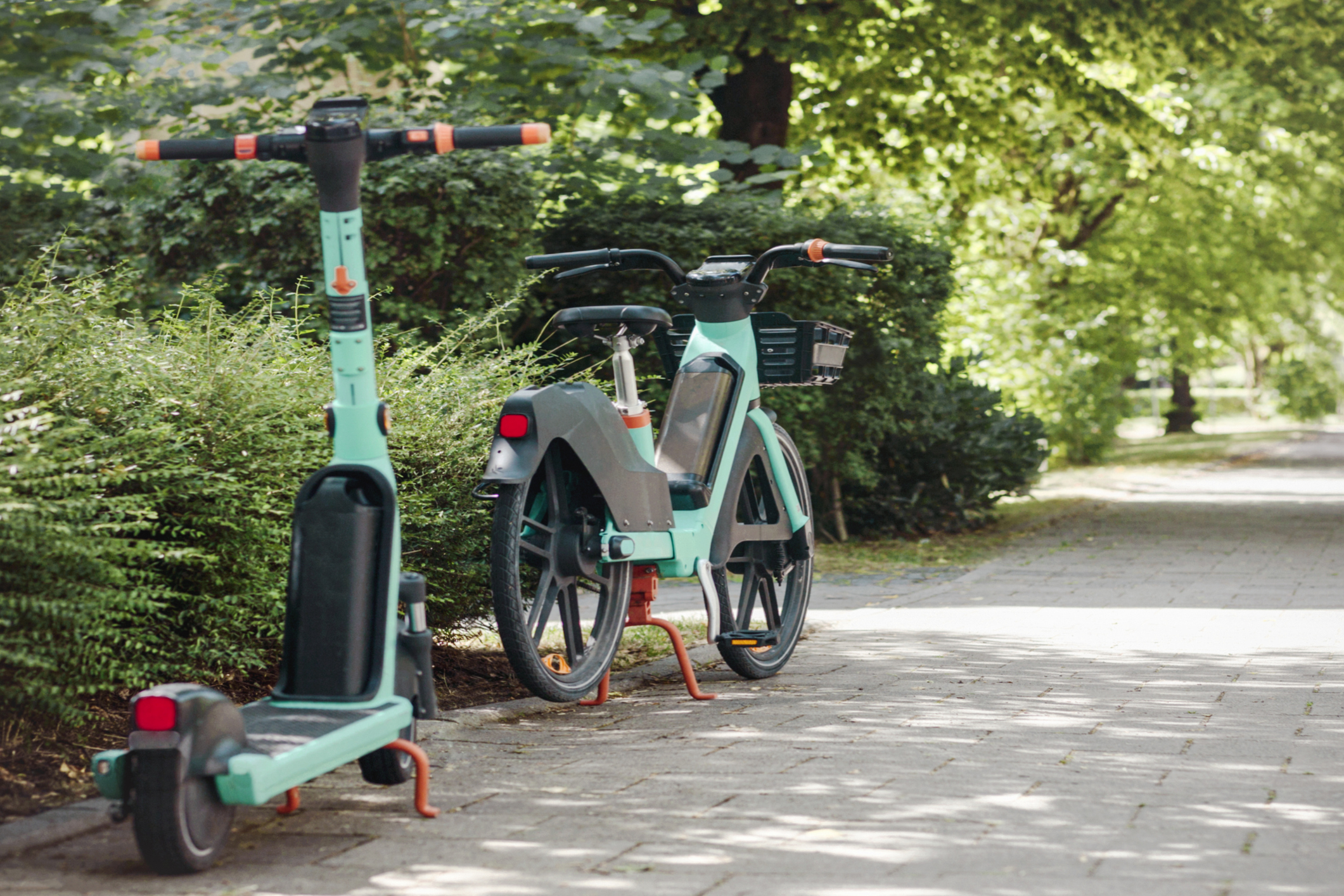
A street-legal e-scooter in Florida has a motor, no more than three wheels, comes with or without a seat for the rider, and goes no faster than 28 mph.
A street-legal e-bike in Florida has working pedals, a seat, and a motor under 750 watts, and it carries a permanent manufacturer’s label listing these three things: its class, its top assisted speed, and its motor wattage.
- Class 1: pedal assist only, motor assists up to 20 mph
- Class 2: throttle capable, motor assists up to 20 mph
- Class 3: pedal assist only, motor assists up to 28 mph
No label?
Don’t assume it’s street legal. And if an e-bike has been modified, “unlocked,” stripped of its pedals, or boosted past its rating, it may not count as an e-bike at all, which can mean it legally needs a license and registration it doesn’t have. Tampering with an e-bike’s speed is against state law (s. 316.20655, F.S.).
Is your ride street legal?
Your ride may not be street legal if it:
- Has been modified to move faster: If your e-bike has been modified to allow it to go faster than 28 mph it is no longer classified as an e-bike and would be subject to State licensing requirements. This also applied for an e-scooter that has been modified to go faster than 28 mph.
- Has features of an “E – Moto”: If your bike is motorized and goes faster than 28 mph, has a battery wattage greater than 750, and is styled like a dirt bike with no pedals, your ride is likely an e-moto which is not allowed on the road without the proper registration tags, insurance, and licensing.
The good news
A legal e-bike needs no driver license, no registration, and no insurance. E-scooters get the same deal. You just have to ride by the rules at all times, and the rules are the same ones that apply to bicycles.
When riding, always be visible, always follow the rules, and always be predictable.
Roads and bike lanes
Every street-legal e-bike and e-scooter can ride where bicycles ride. Use the bike lane where there is one, ride with the flow of traffic, and obey every sign and signal. Riding against traffic is one of the most common ways riders get hit. Drivers pulling out of side streets and driveways aren’t looking for you coming the wrong way.
Trails and shared use paths
E-bikes and e-scooters are welcome on Orlando’s shared-use trails, including the Orlando Urban Trail, Cady Way Trail, and Shingle Creek Trail. People walking always have the right-of-way: slow down, announce yourself, ride on the right and pass on the left with care. Some managed trails post their own rules, so check trailhead signs.
Sidewalks
Sidewalks are allowed in Orlando unless posted otherwise, but a sidewalk belongs to pedestrians first. On a sidewalk you have a pedestrian’s duties: yield to people walking and give an audible signal before you pass. Keep your speed close to walking pace whenever people are around.
Leaving the city?
Rules change at the city line. Winter Park, Winter Garden, and other neighbors have adopted their own e-bike rules (ages, ID requirements, trail and sidewalk limits), and Orange County has rules for riding on school property. Check before you roll somewhere new.
The average cyclist pedals about 12 -18 mph in a bike lane and 10 mph on a sidewalk. An e-device’s motor will carry you at 20 to 28 mph. That gap makes a difference: more speed means longer stopping distances, less reaction time, and harder hits.
Slow down near driveways, intersections, school zones, and anywhere people walk. The throttle can wait.
The numbers
- E-bike injuries sent a record 59,200 riders to U.S. emergency rooms in 2024 (Consumer Product Safety Commission (CPSC)).
- Florida’s 234 bicyclist deaths in 2023 were the most of any state (NHTSA).
- Closer to home, more than half of Orange County’s 2025 micromobility emergency-room visits were riders 19 or younger

Orange County School District estimates that some 11,800 students have been riding e-bikes and e-scooters to school, and the rules for those trips just changed.
If your rider is one of them, you set the terms at home and Florida law backs you up. Parents and guardians may not knowingly let a minor break the state’s bicycle traffic laws.
- New school rules for 2026-27. Orange County Public Schools no longer allows elementary and middle school students to ride e-bikes or e-scooters to school. High school students can, with a driver’s license or learner’s permit and a district-issued decal.
- Match the ride to the rider. Start with the slowest class that does the job. CPSC guidance says children 9 to 12 shouldn’t operate anything that tops 10 mph, and riders 10 to 20 years old have the highest bicyclist injury rates of any age group.
- Buy legal. Skip “unlocked” or modified devices, check for the class label, and use parental speed-limit settings where the app offers them.
- Helmet, every ride. Quick helmet fit checklist: snug, level, and two fingers above the eyebrows. Have rider open wide in a big yawn; the helmet should pull down. If not, tighten the chin strap.
- Make it an agreement. Check out AAA’s free E-Ride Safety Guide which includes a five-minute talk script and a family riding agreement you can sign together.
Lithium batteries are safe until they’re not
Charge with the charger that came with your device, plugged straight into a wall outlet, in a cool, dry spot away from doorways and anything flammable. Don’t charge overnight or unattended, retire batteries that are swollen or smell odd, and avoid aftermarket batteries entirely. When buying, look for UL-certified systems (UL 2849 for e-bikes, UL 2272 for e-scooters).
Your ride is a target
Lock the frame and rear wheel to a rack with a U-lock, cable the front wheel, and take removable parts (battery, display, lights) with you. Then you can register your bike or scooter with the Orlando Police Department. It’s free, takes minutes, and registered rides come home more often.
Register your bike or scooter now
- Give at least 3 feet when passing, more if you can. It’s the law (s. 316.083, F.S.), and if there isn’t room, wait. A few seconds cost nothing.
- Expect e-riders to be faster than they look. Check bike lanes, blind spots, and your right side before turning, especially while making a right on red.
- Slow down near schools, parks, and trail crossings.
Do I need a license, registration, or insurance for my e-bike/e-scooter?
No. Florida treats legal e-bikes and e-scooters like bicycles: no driver license, registration, title, or insurance. All bicycle traffic laws still apply, and riders under 16 must wear a helmet.
What about the rental scooters downtown?
Shared bikes and scooters operate under the city’s Bike Share / Scooter Share Program permits. The riding rules on this page apply to them too, and please park them upright and clear of the sidewalk path. See one blocking the way? Report it online.
My “e-bike” goes faster than 28 mph. Is that legal?
Not as an e-bike. Any bike-styled device that moves faster than 28 mph, skips the pedals, or exceeds 750 watts, including the fast dirt-bike-style electrics sold without pedals, falls outside Florida’s e-bike definition. It may be treated as a different vehicle type with license and registration requirements, and tuning a legal e-bike to go faster is itself a violation.
What are the hand signals?
- Left arm straight out: left turn
- Left arm up at the elbow (or right arm straight out): right turn
- Left arm down: stopping
Glance over your shoulder before you signal and move.
Download FDOT’s pocket guide and view examples
Join the email bike list
Updates on bike projects, helmet fitting trainings and giveaway events, and safety programs, straight from city Transportation staff.
Subscribe now